Beyond Chat: Why the Future of Business Operations is Autonomous
The shift from generative AI to agentic AI, and why the "swivel chair" workflow is finally coming to an end.
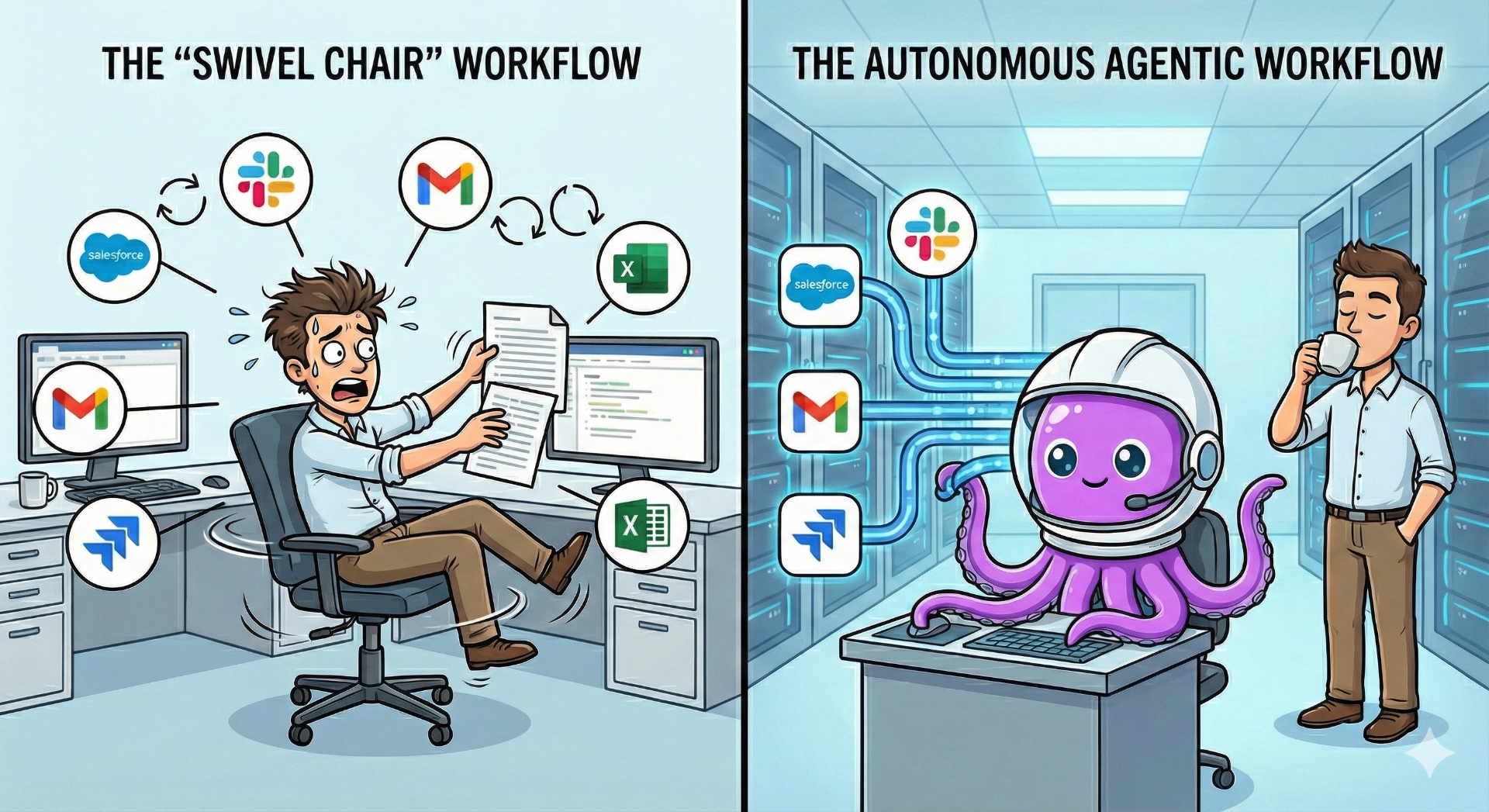
For the last few years, we have treated artificial intelligence like a brilliant, incredibly fast intern. It gives excellent advice, drafts a great email, and can summarize a 50-page PDF in seconds. But at the end of the day, you still can't give it the company credit card, and you certainly can't trust it to update the CRM on its own.
It is an advisory tool. A copilot. And while copilots are helpful, they don't fundamentally change the operational bottlenecks of a business.
That era is ending. We are currently watching the enterprise shift from Generative AI (creating text and images) to Agentic AI (executing multi-step workflows).
The future of business operations isn't about asking an AI to write a response so you can copy and paste it. It is about deploying autonomous agents that act as the intelligent, asynchronous glue between your disconnected systems.
The End of the "Swivel Chair" Workflow
The biggest drag on enterprise productivity today is the "swivel chair" problem. Humans spend a massive percentage of their day manually moving data and context between SaaS tools that APIs never quite managed to fully connect.
An autonomous AI agent breaks this cycle. When granted scoped access to your tools (inboxes, CRMs, ERPs, spreadsheets), an agent doesn't just draft the email. It researches the lead, writes the email, sends it, updates Salesforce, and pings you on Slack with a summary—all while you are in another meeting.
To understand the raw power of this shift, look at how agents are already executing asynchronous workflows across different departments:
1. Revenue & Pipeline Acceleration (Sales/Marketing)
- The Old Way: Marketing exports a CSV of 500 webinar leads. A sales development rep manually looks up each company on LinkedIn, scores them, and puts them into a generic email cadence. By the time they hit "send," the leads are cold.
- The Agentic Way: An agent continuously monitors the inbound lead database. When a new lead drops, the agent autonomously enriches the profile using an external data provider, analyzes the company's recent news, and drafts a highly contextual email into an account executive's draft folder. It then routes the CRM record to the correct rep with a bulleted summary of why they are a good fit.
2. The "Zero-Touch" Resolution (IT & Customer Support)
- The Old Way: IT and Support teams drown in Tier-1 tickets—password resets, software provisioning, and basic policy questions—leaving no time for complex problem-solving.
- The Agentic Way: An agent sits inside the ticketing system (like Jira or Zendesk). When a ticket arrives, it reads the context, checks the internal knowledge base, accesses the provisioning API, and resolves the user's issue directly (e.g., granting software access). It closes the ticket and logs the action in seconds, with zero human intervention.
3. Autonomous Reconciliation (Finance & Admin)
- The Old Way: The dreaded end-of-month scramble. Finance teams spend days manually matching hundreds of PDF invoices to corporate credit card statements.
- The Agentic Way: An agent monitors a dedicated billing inbox. It extracts data from incoming PDFs, cross-references it with the ERP system in real-time, and automatically stages exact matches for payment. It only flags transactions with discrepancies over a certain threshold for human review.
The Infrastructure Reality
This level of operational leverage is incredible, but there is a catch: you cannot just run an open-source script on a laptop and expect it to manage your company's financials safely.
If an autonomous agent is going to execute core business functions, the underlying infrastructure must be enterprise-grade. The agent needs 24/7 uptime. It needs secure environment variables so it doesn't accidentally leak your API keys. It needs strict sandboxing, immutable memory, and clear, role-based access controls (RBAC).
This is why managed platforms like OctoClaw exist. Just as businesses stopped hosting their own email servers decades ago, they shouldn't host their own AI infrastructure today.
To safely scale agentic AI, agile teams need a secure, sandboxed, "always-on" environment. This allows operators to focus purely on designing the workflows and the business logic, rather than managing the complex cloud infrastructure and security perimeters required to keep autonomous models from going off the rails.
Finding Your First Agentic Use Case
You don't need to completely rewire your entire company to start seeing the benefits of autonomous agents. In fact, you shouldn't.
The best way to transition from copilots to autopilots is to start small. Find the highest-volume, lowest-variance process in your department. Find the chore that makes your team feel like data-entry clerks instead of strategic thinkers.
Map out the steps, sandbox an agent to handle the execution, and keep a human in the loop to review the outputs for the first week. Once you see an agent clear your backlog while you drink your morning coffee, you will understand exactly why the future of business operations is autonomous.